
Assess the Results You’re Producing – Why Tracking Matters

In the last article we uncovered the difference between exercise and training. Most people don’t even realise there is a difference. They think showing up to the gym, doing some lifts, and leaving sweaty is enough. But what separates training from exercise isn’t just the choice of exercises — it’s the fact that training is a process, with a clear start point and a long-term objective, reached through well-planned, carefully thought-out workouts.
But there is another key element that separates the two, and it often gets overlooked: recording what you do. Training means you can prove your progress with objective, quantifiable data. That means keeping a logbook. Without one, you’re only guessing — and guessing isn’t training.
Why logging matters
A logbook is the lifeline of your training. It’s not there to make things complicated or give you extra admin; it’s there because it’s the only way to know if what you’re doing is actually working.
When you write things down, you create a permanent record of where you started, what you’ve done, and how far you’ve come. That record isn’t just for nostalgia — it gives you the ability to:
See steady improvement session by session.
Spot patterns in your performance — good weeks, bad weeks, missed lifts.
Give context to your coach (or yourself) when you need to make changes later.
At this stage of your training journey, progress should be fairly linear. You’ll squat, press, deadlift, and bench press, and each session you’ll nudge the weight up a little more. These are the small, incremental stresses that stack up into lasting progress. Your logbook makes that climb visible. Without it, each workout stands alone, disconnected from the last, and you’re back to “I guess I’m improving.”
What to record (and why)
A good training log isn’t complicated, but it is deliberate. Here’s what should go in it — and why it matters.
Date and time of session. This anchors your training to a specific point. Later you’ll be able to look back and see how often you’ve trained, spot gaps, and even notice how different times of day affect your performance.
Exercise name. Your programme tells you what’s planned, but your log shows what you actually did. It’s the evidence that you followed through.
Sets, reps, and weight completed. This is the backbone. Did you hit the 3×5 at the prescribed load? Did you miss a rep? Did you add more weight than planned? The numbers don’t lie — they’re the objective record of your progress.
Subjective notes. This is where you capture the context. A coach’s cue that instantly fixed your form. A reminder that you rushed your rest and it cost you the last rep. A note that you trained tired after a long day. These details don’t seem important in the moment, but three months down the line they explain why your numbers looked the way they did.
It’s the combination of objective data (the numbers) and subjective context (what you noticed, what you learned, how it felt) that makes your logbook such a powerful tool. One without the other is only half the picture.
What a logbook entry looks like
Here’s how a log entry might read in practice — the kind of thing you’d jot quickly in a notebook:
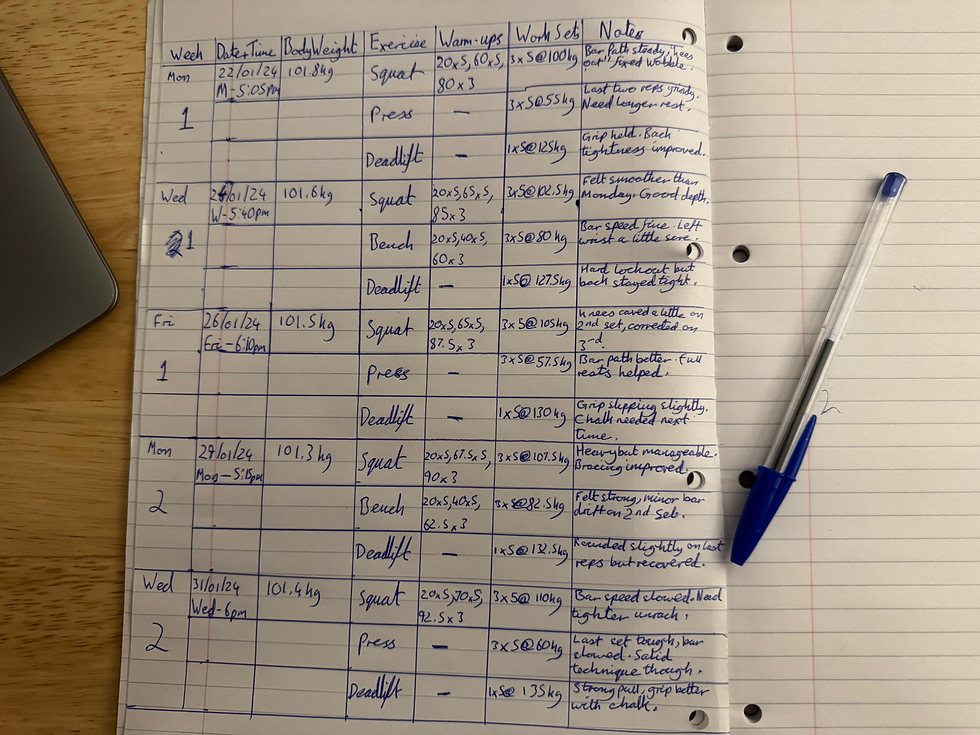
Notice how it’s short and to the point. You don’t need to write an essay — just the essentials: what you lifted, how many reps, and what mattered about the set.
Paper or digital?
A simple notebook will do the job forever. It’s quick to scribble in between sets, cheap, and it never crashes. That’s why so many lifters stick with paper even today.
Digital logbooks and apps add a few extras: instant graphs so you can see the trend line, notes accessible on your phone anywhere, fast communication with a coach, and easy storage of videos or photos.
Both are valid. The “best” logbook is the one you’ll actually use consistently.
Bringing it back to the bigger picture
This series is about why so many people fail when they step into the gym and how to avoid those mistakes. lets consider where we now are in our four step process, and realise we now know:
Define your objective – to increase our muscular strength
Take action – to not just exercise, but to train with a barbell based strength programme, to satisfy the principle of specificity
So here’s the third step in the process:
Assess the results you’re producing - Keep a consistent logbook of your training.
Do this, and you’ll have proof of progress, a tool for learning, and the foundation for making adjustments later. That’s where we’ll go in the final article — how to use the information you’ve collected to refine your plan until you get the results you want.


Comments