
Exercise Wasn't Enough; Strength Mattered More


"I already do 30 or 40 bodyweight squats a day."
I hear this a lot. Usually from people who've read something about muscle loss with age, or seen the usual advice about staying active, and think they're covering themselves. And to be fair, they are doing something right. If you're doing 40 squats a day, you're moving more than most people. That does matter.
But this is where the conversation often goes wrong.
Exercising and being strong are not the same thing.
They overlap, obviously. But they are not identical. And when researchers have looked at which of those things is more closely linked to living longer, strength stands out in a way that simply "doing exercise" often doesn't.
What the Research Actually Found
A 2018 paper by Dankel and colleagues looked at 2,773 adults aged 50 and over. They compared whether people reported doing muscle-strengthening exercise regularly and how strong their legs actually were when tested.
That second bit matters.
Not what people thought they could do. Not what they said they did. Actual measured leg strength.
Then the researchers followed those people over time and looked at cancer-specific mortality.
What they found was striking. Simply reporting that you did muscle-strengthening exercise at least twice a week was not associated with a meaningful reduction in cancer death risk in that analysis. But being in the top quartile for leg strength was associated with about a 50% lower risk.
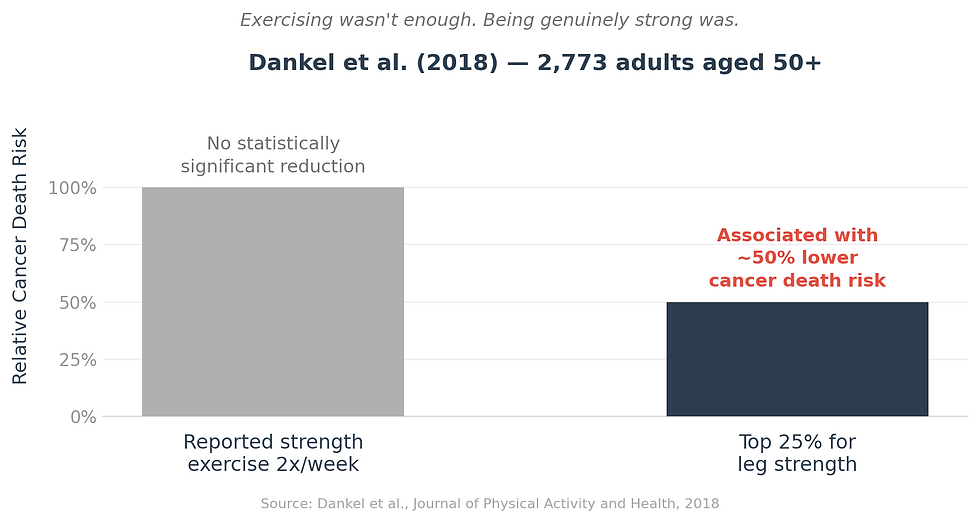
So the issue was not just whether someone was "doing the exercises". It was whether those exercises had actually made them stronger.
Another large study by Ruiz and colleagues found something similar. Greater muscular strength was associated with a lower risk of death from all causes and from cancer, even after accounting for fitness and other factors.
That does not mean exercise is pointless, or that fitness does not matter. It means strength appears to matter in its own right.
Why Bodyweight Squats Stop Being Enough
This is the part people often don't like.
If you squat your own bodyweight 40 times a day, every day, your body will adapt to that. At first, that is useful. You get better at it. It feels easier. You may feel fitter and more capable.
But once your body has adapted, the exercise stops driving much further change.
If the demand never rises, the result usually stops rising too.
That is where people confuse movement with progress. Repeating the same task at the same load may help you maintain something for a while, and that is still better than doing nothing, but it is unlikely to keep building strength indefinitely. At that point, what you are mostly practising is muscular endurance.
That has value. But it is not the same as strength.
Strength is about force production. If you want more of it, then at some point the body has to be asked to produce more force than before.
Why the Weight Has to Go Up
This is the basic idea behind progressive overload.
If you want the body to improve, you have to ask it to do a bit more over time.
For strength, that usually means the load has to rise gradually. Not in silly jumps. Not with ego. Just enough that the body keeps getting the message that what it handled last month is no longer enough.
The same logic applies to bone. Bone is living tissue. It adapts to loading. Give it a reason to become denser and stronger, and it responds. Never challenge it beyond a very low level, and there is no reason for it to improve.
A bodyweight squat does put force through the legs and spine, and for some people it is a perfectly sensible place to start. But once your body has adapted to that load, the challenge is capped. Your muscles are no longer being asked to do more than they already can. Your bones are no longer being given much reason to become stronger.
So yes, bodyweight squats can be a starting point.
They are just not the end point.
Why the Barbell Matters
This is where the barbell becomes useful.
Not because it is hardcore. Not because it looks impressive. Just because it lets you increase the load in small, exact amounts.
That matters because if strength is one of the physical qualities most closely tied to staying capable later in life, then it needs to be trained properly. And proper training means being able to measure the demand.
With bodyweight work, people often rely on effort. It feels hard, therefore it must be working.
Sometimes it is. Sometimes it isn't.

In my gym, I have bars that weigh just 7 kilograms, safety squat bars at 10 kilograms, and fractional plates as small as 0.125 kilograms. That means a 70-year-old coming in for the first time might squat 25 kg on Monday, 25.25 kg on Wednesday, and 25.5 kg on Friday.
Tiny jumps, but real progress.
And if that person cannot squat with a bar at all, that is fine. We start where they are. If they can stand from a chair, we begin there. If they need help to do that, we reduce the challenge further and build from there.
There is always a starting point.
The Thing People Are Told to Avoid
This matters especially when it comes to backs and bones, because this is where fear tends to take over.
I hear it all the time: "I've been told not to put stress through my back."
Usually that advice is well meant. But taken too literally, it becomes a problem.
Because bones, muscles, tendons, discs and joints do not become more resilient by being spared all challenge forever. They adapt to what they are exposed to.
If you want your spine to tolerate force better, then over time it has to be exposed to force. Sensibly. Gradually. Properly coached. But exposed to force all the same.
That does not mean recklessness. It means starting at the right level and building carefully.
Studies on supervised resistance training in older adults with low bone mass have shown that even people with osteopenia or osteoporosis can improve bone measures and physical function under the right conditions. The point is not that everyone should start lifting heavy on their own tomorrow. The point is that loading itself is not the villain people have been taught to fear.
The Real Message
The real message here is not that bodyweight squats are bad.
They're not.
The real message is that they are often a gateway, not a destination.
If the body adapts and the challenge never changes, then sooner or later the benefit stops changing too. And the thing the research keeps pointing back towards is not just exercise for the sake of it, but strength. Measurable strength. Actual force-producing capacity. The kind that helps you get off the floor, climb stairs, catch yourself when you trip, and stay physically independent for longer.
That is the bit worth training for.
In the last article, the message was simple: start.
This month, the message is slightly different.
Start, yes.
But then keep going.
And when you can, add weight.


Comments